
Buying guides
How to Plan a Wholesale Kids’ Underwear Size Assortment
Build a wholesale kids’ underwear assortment with one row for each exact style and requested height. Count ready-stock quantities in complete four-piece sets, total the individual garments separately and ask the supplier to confirm the proposed mix. Use your own customer evidence to choose quantities instead of applying a universal size ratio.
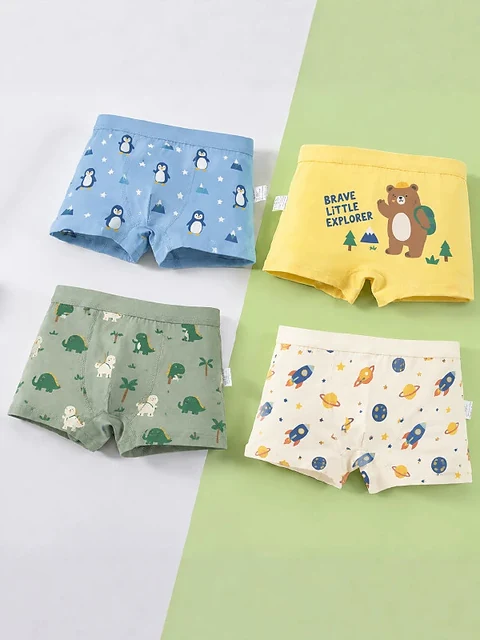
The penguin adventure boys’ set is one product reference for an assortment plan. Its four coordinated designs belong to the same set and should stay together in the buying brief.
Make style and height the smallest useful buying line
An enquiry for “mixed children’s underwear” is difficult to confirm. It hides which products the buyer actually wants and where the quantities belong. Start with a short list of exact catalogue products. Give each product and height combination its own line, even when several lines share the same fabric composition.
Keep boys’ boxer briefs, girls’ boxer briefs and girls’ briefs visible as separate buying groups. They meet different assortment choices and should not share a size allocation merely because the numbers look tidy. Compare the boys’ boxer brief range and girls’ brief range, then select the products your shop intends to offer.
Choose a starting mix from the information you have
Existing shops can review recent unit sales, size enquiries and out-of-stock requests for comparable products. Keep the period and channel beside the figures. A best-selling size from a different cut or an older customer group may offer a poor starting point for this purchase.
A new shop may have no sales history. In that case, write down the intended child-height range, selected styles and the limits of the available evidence. Use a small proposed assortment to begin the supplier conversation. Ask which lines are available before promising a complete size run to customers. There is no verified universal size ratio for every retailer, country or sales channel.
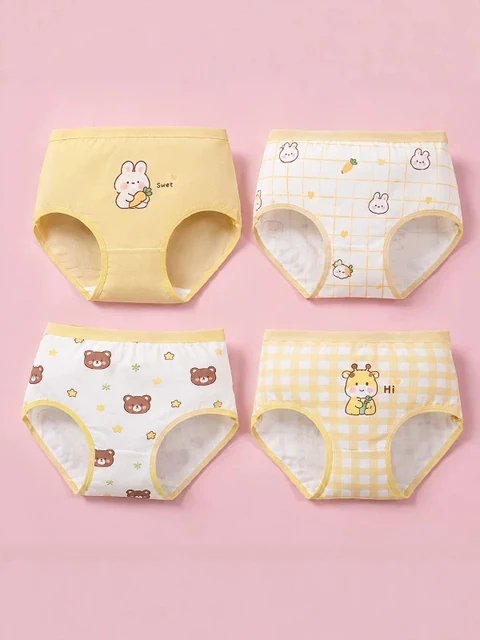
The bunny and bear girls’ brief set has a different silhouette and print combination. Keep its requested heights and quantities on its own order lines.
Use a worked example to check the units
| Catalogue style | Requested height | Complete sets | Individual garments |
|---|---|---|---|
| Penguin adventure boys’ boxer brief set | 100 cm | 2 | 8 |
| Penguin adventure boys’ boxer brief set | 110 cm | 3 | 12 |
| Penguin adventure boys’ boxer brief set | 120 cm | 1 | 4 |
| Bunny and bear girls’ brief set | 110 cm | 2 | 8 |
| Bunny and bear girls’ brief set | 120 cm | 3 | 12 |
| Bunny and bear girls’ brief set | 130 cm | 1 | 4 |
| Planning total | Illustrative allocation | 12 | 48 |
The table is a hypothetical planning example for two catalogue sets. The requested heights are within the published range, but the quantities are illustrative. They do not describe current inventory, supplier-approved mixed sizing or a recommended sales ratio. Each row counts complete sets of four garments.
Six sets of the penguin design plus six sets of the bunny and bear design produce 12 sets in this example. Multiplying 12 by four gives 48 individual garments. Keep those totals next to the order rather than making a supplier infer whether “48” refers to pieces, sets or packs.
Add confirmation columns before treating the mix as an order
| Purchase-order field | Purpose | Decision to record |
|---|---|---|
| Exact product link or name | Identify one four-piece assortment | Selected style |
| Requested height and set quantity | Show the buyer’s proposed allocation | Requested |
| Supplier-confirmed set quantity | Show available and agreed lines | Confirmed or pending |
| Substitution or split delivery | Make a proposed change visible | Accepted, rejected or open |
| Version and approval | Keep purchasing and receiving aligned | Name and date |
A requested allocation is the buyer’s proposal. Add a supplier-confirmed quantity and an open-issue field so an unavailable line cannot disappear into a total. If the supplier suggests a different print or height, review that change explicitly before agreeing the order.
Record whether a substitution is accepted, rejected or awaiting a decision. Keep one current version of the matrix and identify who approved it. The receiving team should be able to compare delivered style and height counts with the same confirmed lines, using the receiving-order checklist when the goods arrive.
Keep fit decisions attached to the product reference
The current LULUNIO catalogue lists heights from 100 to 140 cm and product-specific body-weight guidance. Use those references to prepare the enquiry, then request garment measurements where a fit decision needs more detail. Height labels do not turn all styles into an interchangeable size system.
If one sample leads you to change the requested allocation, identify which product was evaluated and what changed. The garment measurement sheet helps preserve that evidence. Do not apply a measurement from a girls’ brief sample to a boys’ boxer brief simply because both carry the same height label.
Send the assortment with the destination and buying route
For LULUNIO ready stock, the published starting minimum is 1 complete set containing 4 garments. Send your line-by-line proposal through the wholesale enquiry page and request availability, quotation, shipping and dispatch confirmation. The starting minimum does not establish every possible style-and-size combination.
For a custom collection, rewrite the matrix in individual garment pieces. Custom enquiries start at 100 pieces, with the breakdown by style, colour, size and proposed packaging reviewed for the order. Use the packaging specification brief to show how those garments should become retail packs. After a first purchase, record sales by the same style and height fields so the next assortment can be based on observed demand.
Buyer questions
Can I mix different heights in a ready-stock order?
Send the exact allocation by style and height. LULUNIO will confirm availability and the proposed assortment in the quotation. The starting minimum alone does not approve every mix.
Is there a standard size ratio for a first order?
This guide gives no universal ratio. Use the intended customer range and your own sales or enquiry evidence, then confirm the proposed quantities with the supplier.
How many individual garments are in 12 complete sets?
At four garments per set, 12 complete sets contain 48 individual garments. This arithmetic does not confirm stock availability or the allocation by height.
Does the 100-piece custom minimum apply to each size?
The published starting minimum counts individual garments. Confirm the per-style, colour and size breakdown for the specific custom brief before placing an order.